Guides / Process
Why a One-Off Large Part Needs a CAM Prove-Out Before the First Cut
October 10, 2026
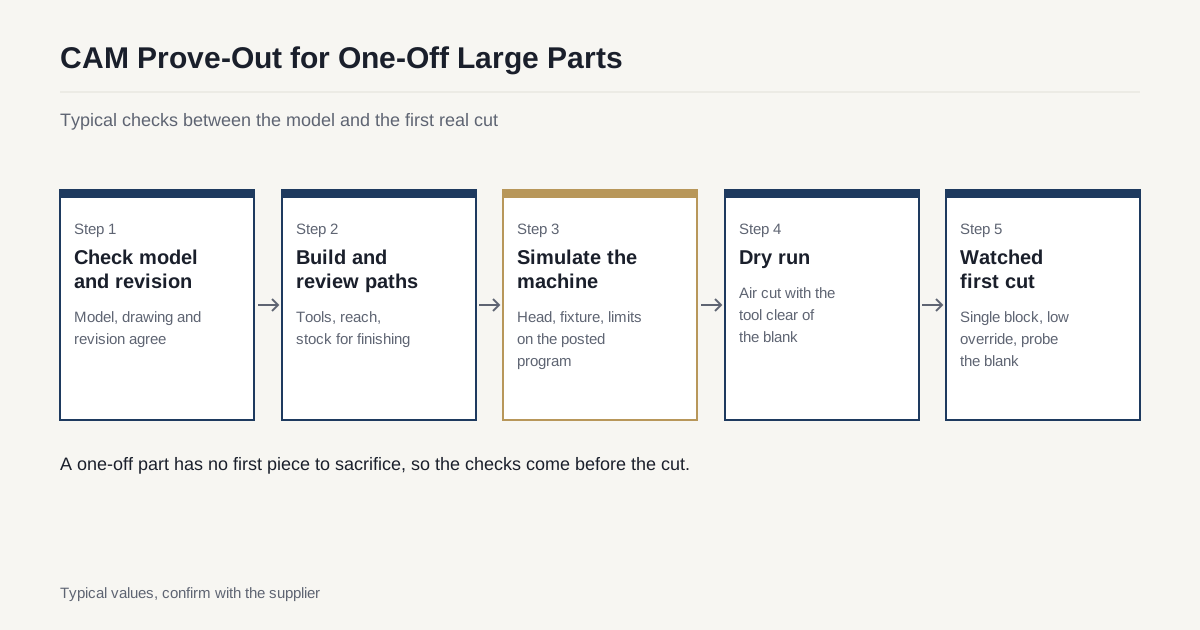
On a batch of small parts, the first piece is the prove-out. If the program is wrong, a cheap blank is lost and the program is corrected. On a one-off large part there is no first piece to sacrifice. The blank may cost more than the whole machining job, and the machine time spent before a mistake may be days.
This guide explains what a CAM prove-out covers, what it costs and what you can ask for as a buyer.
What can go wrong on a large part
Most errors in a first cut are not subtle. They are things like these.
- A tool that gouges a surface because the toolpath was built on an old model revision.
- A holder or spindle nose that collides with a clamp, a raised pad or the part itself.
- A tool that is too short to reach the bottom of a deep pocket, or too long to fit under a head limit.
- A move that runs the machine into a travel limit on one axis halfway through a pass.
- A wrong work offset, which puts every cut in the wrong place.
- A post-processor setting that outputs a move the machine interprets differently from the simulation.
On a large machine each of these can cost more than the part. A collision on a big spindle may damage the head, and the repair takes the machine out of service for weeks. That is why careful shops treat the prove-out as part of the job and not as a delay.
The usual prove-out steps
Check the model and the revision
The first step is boring and essential. The shop confirms that the model matches the drawing, that both carry the same revision and that all the features are present. Any difference is resolved before programming starts, not after.
Build and review the toolpaths
The programmer chooses tools, speeds and feeds, and builds the toolpaths from the model. On a large part this includes a roughing strategy, a plan for stock left for finishing and a sequence that respects clamping and stress. The programmer also checks tool reach and holder clearance for each operation.
Simulate against a model of the machine
Good simulation includes more than the part. It models the machine with its axis limits, the head, the fixture and the clamps, and it checks the real program, including the output of the post-processor, rather than the toolpaths alone. This is how collisions with fixtures and head limits show up. The simulation also compares the cut with the model, so gouges and uncut areas are visible.
Dry run
The shop runs the program on the machine with the tool clear of the blank, either with an offset that lifts it a safe distance or with no tool in the spindle. The operator watches the axes move and checks that the real machine behaves like the simulation. This catches post-processor issues and offset errors that simulation cannot.
First cut under watch
The shop cuts the first operation slowly, often in single-block mode with the feed and rapid overrides turned down. The operator checks the first pass against the part before the program runs unattended. On large parts the first cut is also a check of the real blank against the model, since a blank can differ from its drawing.
| Prove-out step | What it catches | Typical time on a large part |
|---|---|---|
| Model and revision check | Wrong revision, missing features | Under an hour |
| Toolpath review | Gouges, wrong tools, reach problems | Hours, scaled to part complexity |
| Machine simulation | Collisions, travel limits, post errors | Hours to a day on complex parts |
| Dry run | Offset errors, post differences | An hour or two |
| Watched first cut | Blank differences, tool behaviour | Part of the first operation |
The figures are typical, so confirm them with the supplier.
Probing and blank checks
A large casting or forging is rarely exactly what the drawing assumed. Cores shift, skin varies and a blank can be several millimetres off in a way that matters. Many shops probe the blank before the first cut, measuring datum surfaces and checking that every machined feature has enough stock.
Probing is also a way to set work offsets accurately. A probe on a large machine can find the part’s position in a few minutes, which is faster and more reliable than setting it up with a dial indicator. For tolerances across a large part, the datum strategy in the drawing should match what the probe measures.
On a part with a casting skin, a probing step can show that the allowance is too small in one spot. That is the time to learn it, before the first cut and not halfway through a finishing pass. See machining allowance on large blanks for how shops plan around blank variation.
What the prove-out costs
The cost has three parts: programming hours, simulation hours and machine time for the dry run and the slow first cut. On a complex one-off, the programming alone can take days, and a shop may price it as a separate line.
This can look high when you compare it with a repeat part, where the program is reused. It is not high when you compare it with scrapping a part. A blank in alloy steel or a large casting may cost many thousands, and the machining before the mistake adds to that. Most buyers who think it through accept the prove-out cost as insurance.
If you expect to reorder the part, say so. The program will be reused, and a shop may spread the programming over the first and later orders, which lowers the first quote. The large part machining cost guide shows where programming sits among the other hours.
A worked example
Picture a welded press frame, 4 metres long, programmed for a gantry mill with a swivel head. The programmer builds the roughing and finishing paths in a day and then loads the full machine model into the simulator. The simulation shows that the head, tilted for a side bore, comes within a few millimetres of a clamp that holds the far end of the frame. Nothing has been cut yet, and the fix is to move the clamp and re-run the check.
On the machine the shop runs the program with the tool raised well above the blank. The dry run shows that the first move goes to the wrong corner. The cause is a work offset entered with the wrong sign. It takes a minute to fix, and it would have cut a pocket in the wrong place on a part that took a week to weld.
Then the probe measures the blank and finds that one face sits 3 mm lower than the model. The programmer adjusts the depth of the first roughing pass. Each of these catches costs minutes. Missing any of them would have cost the part.
Who is responsible for what
The shop owns the program and the checks, and it is responsible for the part it cuts. As a buyer you own the inputs: a clear drawing, a matching model and an honest description of the blank. If the drawing is ambiguous, a good shop will ask. Answer quickly, because the question usually arrives while programming is waiting.
Some buyers ask to approve the program before cutting. For most parts this is not useful, because a G-code file is hard to read and a simulation video says more. Ask to see the simulation on parts that are valuable or unusual, and leave the rest to the shop’s process.
Prove-out on repeat orders
The first part pays for the prove-out, and later orders can reuse most of it. Even so, a shop will usually repeat the dry run when the program has been idle, when the machine has changed or when the model revision has moved. A rerun costs far less than the first run. If the part will be ordered again, ask the shop to keep the program and the fixture notes, and note the revision on each order.
What a buyer can ask for
You do not need to supervise the shop, but a few questions show how it works.
- Do you simulate with a model of the machine and fixtures?
- Does the simulation run on the post-processed program?
- Do you probe the blank before cutting?
- Will you share simulation images or a short video of the first operations?
- How do you control revisions between the model, the drawing and the program?
Shops with a good process answer these quickly. A shop that hesitates on the first two may still make good parts, but it is relying on the operator’s experience more than on checks.
Model files and revisions
The model is the input to the whole process, so send a clean one. A STEP file of the finished part is usually enough, and a model of the blank helps when you have it. Include the drawing at the same revision. If the model and the drawing disagree, tell the shop which one governs.
When a revision changes mid-job, tell the shop at once. A change after programming can mean reprogramming and a new prove-out, and the earlier you say so the less it costs. A small note on the RFQ about expected revisions lets the shop decide how to sequence the work.
Closing checklist
- Send the model and the drawing at the same revision, and say which governs.
- Say whether the part may be reordered, so the program can be reused.
- Ask whether the shop simulates the full machine and the post-processed program.
- Ask whether the blank is probed before the first cut.
- Ask for images of the simulation on high value parts.
To bring all of this into one request, use the RFQ form and add the model and revision notes there.
Frequently asked questions
What is a CAM prove-out?
It is the set of checks a shop runs on a program before it cuts the real part. Typical steps are checking the model, simulating the toolpath against a model of the machine and fixture, an air cut with the tool clear of the blank and a careful first cut with the operator watching.
Does a prove-out add to the price of a one-off part?
Yes, as programming and machine time. It is usually a small share of the total, and it is cheap compared with the cost of scrapping a part that has already absorbed days of machining.
Can I see the simulation?
Many shops will share a video or screenshots on request, especially on high value parts. Ask for it in the RFQ if you want it, and expect to agree on confidentiality of the model.
Need a quote for a part like this?
Send the drawing with the envelope and finished weight. We match you with up to 3 shops that take parts this size and reply within 24 business hours.
Get matched with a large part shop