Guides / Process
When Five-Axis Machining Is Worth Paying for on a Large Part
October 12, 2026
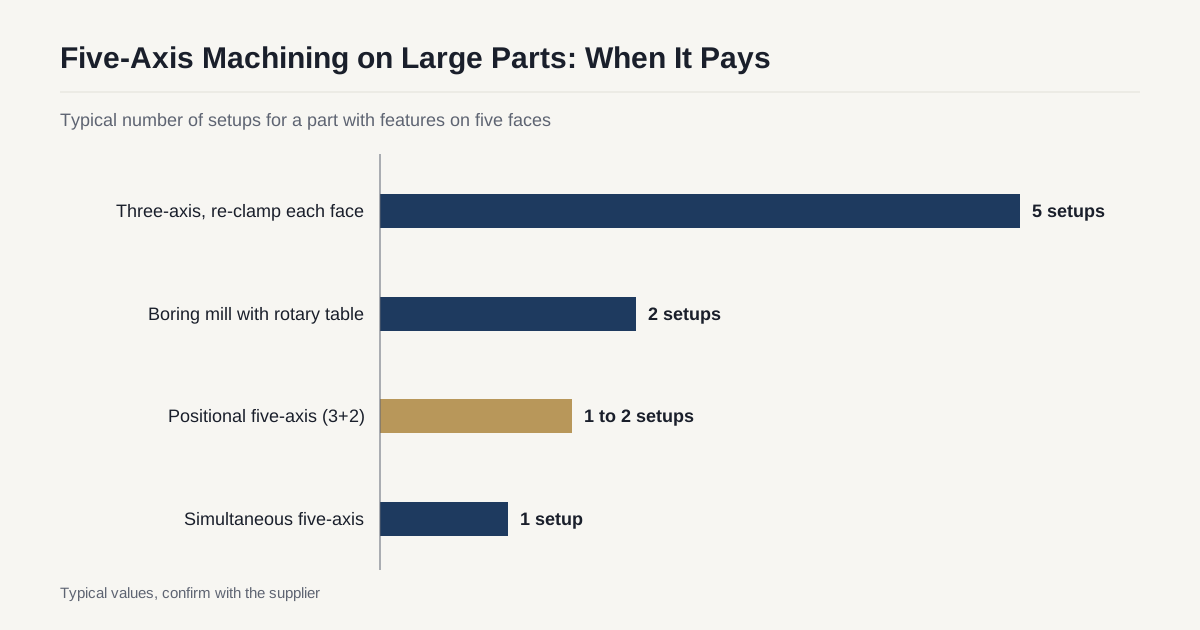
A large part with features on several faces usually costs more in handling than in cutting. Five-axis machining attacks the handling. It costs more per hour, and on the right part that still lowers the total.
This guide explains where five-axis work pays on parts that fill a big table or a gantry, where it does not, and what to put in an RFQ so the quotes you get describe the same job.
Three kinds of five-axis work
The phrase covers three different jobs, and they are priced differently.
Angled-head work. A three-axis machine fitted with a right-angle or universal head. The head is locked at an angle, then the machine cuts as a three-axis machine. It reaches faces a plain vertical spindle cannot, but each head change takes time and the head is less rigid than the main spindle.
Positional five-axis, also called 3+2. Two rotary axes position the tool or the part, lock, and a normal three-axis cycle runs. This is the workhorse for holes and faces at compound angles. The programming is close to three-axis work and the cutting forces are the same as in any rigid setup.
Simultaneous five-axis. All five axes move together while cutting. It is needed for continuous curved surfaces such as impeller passages, blended casing walls and sculpted forms. Programming and proving out take far longer, and a collision on a large part is expensive.
Most large prismatic parts need the first two. Only a small share need the third.
Where five-axis pays on a large part
Count the faces that carry features. The more faces, the more a single setup is worth.
A fabricated frame with bores on three sides, a housing with angled flange faces and a casing with a mounting face at a compound angle all follow the same logic. Each extra setup on a large part means a crane lift, a new alignment and a new chance for the features to drift out of position relative to each other. Hours are lost indicating the part in again, and on a part weighing several tonnes that is not a quick job.
Position between faces is the other gain. Features cut in one clamping share one reference. Features cut across two setups depend on how well the part was re-indicated. If the drawing has a tight positional tolerance between a bore on one face and a pattern on another, one setup is the safest route. The datum strategy in the drawing decides how much that matters.
Access is a third reason. A swivel head can reach into a recess or under an overhang with a shorter tool than a vertical spindle needs. A shorter tool means less deflection and a better finish.
Where it does not pay
Plain prismatic parts do not need it. A flat plate or a base with every feature on the top face gains nothing from extra axes and pays for the higher hourly rate.
Deep bores are the second case. A horizontal boring mill spindle extends further and stays stiffer than a swivel head can. If the part is mostly bore work, read boring mill versus gantry mill before assuming five-axis is the better answer.
Very heavy cuts are the third. Swivel heads and rotary tables are built for positioning and finishing. Heavy roughing in steel often goes on the most rigid machine the shop has, and the part moves to a five-axis machine only for the angled features.
What changes in the quote
The hourly rate is higher. Part of the premium pays for the machine and part for programming time, which is larger because the toolpath must be simulated against the full machine, the fixture and the part.
| Cost item | Plain three-axis | Positional five-axis | Simultaneous five-axis |
|---|---|---|---|
| Machine hour rate | Baseline | Often 1.2 to 1.6 times baseline | Often 1.5 to 2 times baseline |
| Programming effort | Baseline | 1.2 to 1.5 times | 2 to 5 times |
| Setups on a five-face part | 4 to 6 | 1 to 2 | 1 |
| Prove-out time | Short | Short to moderate | Long |
These are typical ranges. The real figures depend on the shop and the machine, so confirm them with the supplier.
The saving shows in the setup row. On a part with five faces, going from five setups to one removes four lifts, four alignments and the idle time between them. On a part that is cheap to move that saving is small. On a part that needs a crane for every turn it is large.
Check the machine, not just the label
A rotary axis that is slightly off causes position errors that no program can fix. Ask how the shop checks the rotary axes and the swivel head, and how often. Reasonable answers include a probing cycle on a reference artefact and a periodic calibration with a ball bar or a laser-based method. You do not need the exact method. You need confirmation that someone checks.
Load is the second check. A rotary table has a rated load, and a very large part can exceed it or sit close to the limit with the part offset from the centre. The table load and crane capacity guide explains why the finished weight matters as much as the blank weight.
Travel is the third. A five-axis machine may have a large X and Y but a small usable envelope once the head is tilted, because the tilted head and tool length reduce the reach. Tell the shop the full envelope, the tallest feature and the deepest pocket.
A worked example
Take a welded gearbox-style housing, about 2.5 metres long, with a bearing bore on each end face and a mounting flange on the underside at a small angle to the base. Done on three-axis equipment with an angle head, the shop faces the top, lifts the part to reach the end faces, lifts again for the flange and then goes back to check the first face. That is four or five setups, and the bores on the two ends are related only through the alignment of each lift.
On a five-axis gantry the part is clamped once. The head tilts to reach each end face and the flange. All three groups of features are cut from the same reference, so the relationship between them depends on the machine geometry rather than on three alignments. The hour rate is higher, but the idle time and the lifts are gone, and the shop can quote a firmer number because there is less to go wrong between setups.
Now change the example. If the same housing had every feature on the top face, the five-axis route would cost more and deliver nothing. The part is the same size and weight. Only the feature layout changed, which is why the layout, not the size, drives the choice.
Sequence matters as much as the machine
Even on a five-axis machine, roughing and finishing are different jobs. A large blank often goes through a roughing pass, a rest period or a stress relief cycle, and only then the finishing passes that set the final dimensions. A shop that quotes a single clamping from raw blank to finished part may be skipping that rest. Ask whether the sequence includes it, and whether the bores are finished last.
Fixturing also changes. A part clamped for five-axis work has to leave the tool clear of the clamps from every angle, so clamps sit lower and in different places than in a plain setup. That can reduce clamping stiffness on thin sections, which is one more reason to give the shop the model rather than a drawing alone. See workholding for large parts for what a shop weighs when it plans the clamping.
What to put in the RFQ
Shops can only compare their quotes if they are quoting the same job. For a five-axis part, add these items to the usual list in what to put in a large part RFQ.
- Which faces carry features, and which feature relationships are toleranced tightly between faces.
- Any surfaces that are continuously curved, with the model supplied as a solid.
- The finished weight and the largest envelope in X, Y and Z.
- The surface finish on any blended or contoured faces.
- Whether you accept a split route, with roughing on one machine and finishing on another.
A 3D model helps a lot here. A drawing alone makes it hard to judge whether the angled features are 3+2 or simultaneous work, and shops will price the safer, more expensive reading.
A simple decision rule
Ask three questions before requesting five-axis.
- Do features sit on three or more faces with a tolerance between faces?
- Is the part awkward to lift and re-align?
- Are any surfaces continuously curved?
If the answer to the first two is yes, positional five-axis is often worth quoting alongside the plain route. If the answer to the third is yes, simultaneous work is needed and the shop list will be shorter. If all three are no, ask for the plain route and do not pay for axes you will not use.
Closing checklist
- List the faces that carry features and mark the tolerances between them.
- Say whether any surface is continuously curved.
- Give the finished weight and the full envelope.
- Ask each shop how it checks its rotary axes.
- Ask for the plain route and the five-axis route as two lines, so you can see what the extra axes buy.
When the part is ready to quote, send the drawing and model through the RFQ form and say which faces matter most.
Frequently asked questions
Is five-axis machining more accurate than three-axis on a large part?
Not by itself. The gain comes from fewer setups, because every re-clamp adds its own error. A five-axis machine with a poorly checked rotary axis can be worse than a three-axis machine with a careful setup. Ask how the shop verifies the rotary axes.
Can a gantry mill with a swivel head replace a boring mill?
For many parts, yes, especially when the features are on the top and sides of a part that is too big to move. For deep bores a boring mill spindle is still stiffer. Describe the deepest bore in the RFQ so the shop can say which route it would use.
How do I know if my part needs simultaneous five-axis?
Only continuous curved surfaces need it, such as blades, blended casings and sculpted forms. Holes and faces at fixed compound angles need positional five-axis, often called 3+2, which is cheaper and easier to prove out.
Need a quote for a part like this?
Send the drawing with the envelope and finished weight. We match you with up to 3 shops that take parts this size and reply within 24 business hours.
Get matched with a large part shop