Guides / Process
Which Cutting Tools Do the Heavy Roughing on a Big Blank
October 13, 2026
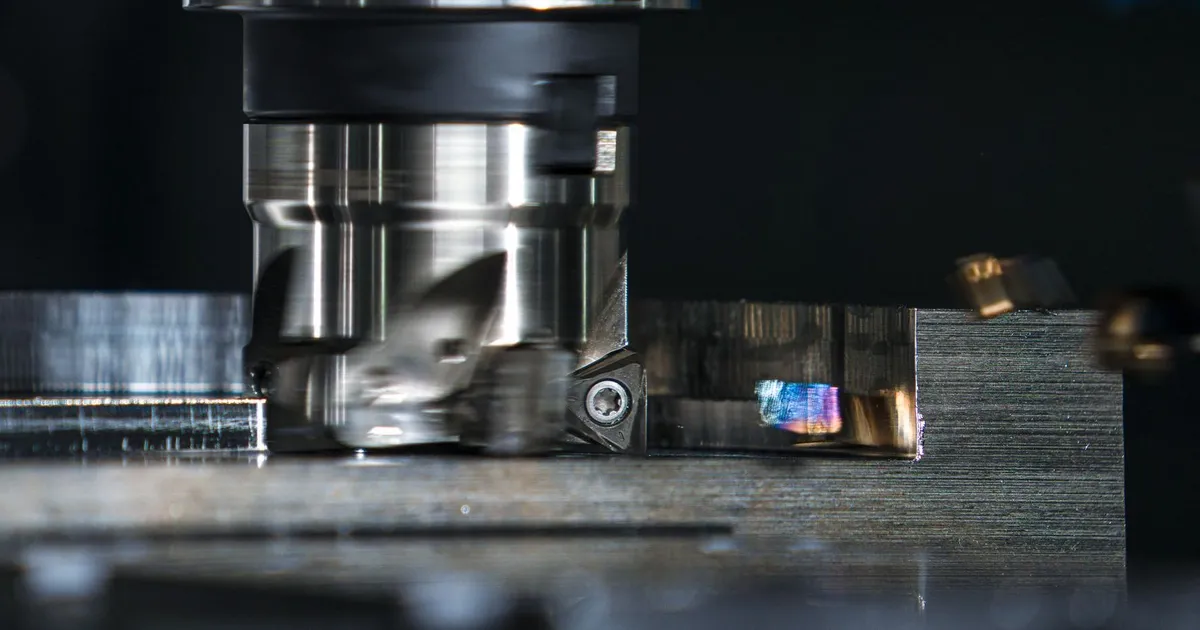
On a large part, roughing is where most of the machine hours go. A blank that weighs 5 tonnes and finishes at 2 tonnes loses 3 tonnes of metal on the way, and that metal comes off a few kilograms at a time. How the shop does it decides a large share of the quote.
This guide explains the cutter styles used for heavy roughing, how a shop chooses between them and what in your RFQ changes the answer.
What limits roughing
It is easy to assume a better insert cuts faster. In heavy roughing the limit is usually the machine and the setup.
Spindle power and torque. A large cutter at low rpm needs high torque, and a deep cut in steel needs power. The shop programs a cut the spindle can sustain without stalling.
Rigidity. The cutter, the holder, the spindle, the column and the fixture form a chain, and the weakest link sets the chatter limit. The vibration and chatter guide covers how that shows up on large machines.
Chip clearance. A deep cut produces a lot of chips, and they must leave the cut. Chips that stay in the cut get recut, which destroys inserts.
Tool life. A heavy cut can run for an hour or more. An insert that wears out midway leaves a step and a scrap risk, so shops plan inserts to last through the pass.
Four common roughing approaches
Square-shoulder face mills
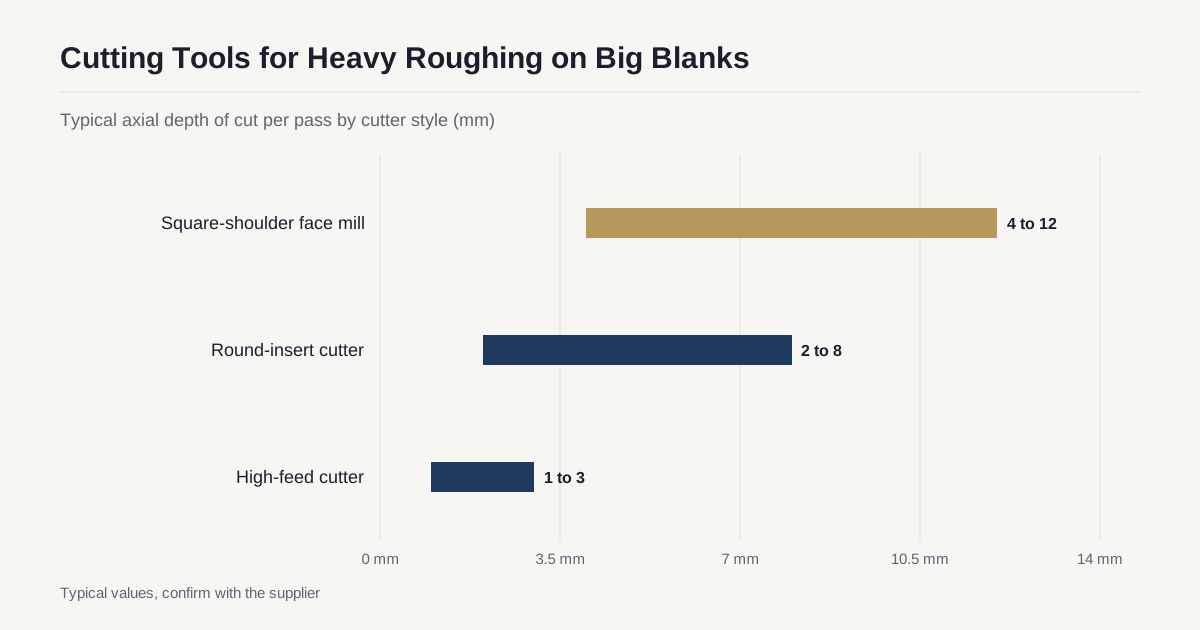
A cutter with a 90 degree entering angle and several inserts. It cuts a floor and a wall at once, which suits shoulders, pockets and flat faces. Depth of cut per pass is substantial, and the cutter works at moderate feed per tooth. It is the general-purpose choice for roughing steel and cast iron when the cutter can reach the whole area.
Round-insert cutters
Cutters with round inserts, sometimes called button cutters. The round edge is strong and spreads the load, so these cutters tolerate interrupted cuts and rough skin. They also thin the chip, so the feed per tooth can be higher than the insert thickness suggests. They are popular for roughing hard materials and forgings, and they leave a scalloped surface that finishing removes.
High-feed cutters
A cutter with a small entering angle, often near 10 to 15 degrees. The chip is thin and wide, so the cutting force acts mostly along the spindle axis, which is the stiffest direction on most machines. These cutters take a shallow depth at a very high feed and work well with long tool reach. They are a good answer to deep pockets and long overhang, where a conventional cutter would chatter.
Plunge milling
The cutter is fed along the spindle axis like a drill, then moved sideways and plunged again. Force goes along the spindle, which is very stable, so plunge milling can rough deep cavities with long tools that would not survive side cutting. It suits deep pockets in steel and in difficult materials, and it is a common choice on a large boring mill with long spindle reach.
| Approach | Typical axial depth per pass | Best for | Watch for |
|---|---|---|---|
| Square-shoulder face mill | 4 to 12 mm | Shoulders, faces, open pockets | Needs stiff setup and power |
| Round-insert cutter | 2 to 8 mm | Forgings, skin, hard materials | Scalloped floor to clean up |
| High-feed cutter | 1 to 3 mm | Deep pockets, long reach | Leaves stock for a second pass |
| Plunge milling | Plunges of tool length | Deep cavities, long overhang | Corner clean-up needed |
These are typical ranges, so confirm the real values with the supplier.
Insert grades and materials
Inserts are chosen by material. Steel calls for tough coated carbide grades. Cast iron wears inserts abrasively and often cuts better dry or with an air blast. Stainless steel is hard on inserts and work hardens, and nickel alloys wear and notch them quickly. The materials for large machined parts guide describes how each behaves.
For the first cut under a rough skin, shops use a tougher grade than they would for a clean surface. Cast skin, forging scale and flame-cut edges are hard and abrasive, and the first cut under them is the most expensive for the insert. A shop that plans a deep first cut below the skin saves inserts and time.
Coolant and chips
Heavy roughing generates a lot of heat. In steel, flood coolant helps tool life in many cuts, though interrupted cuts can suffer from thermal cracking of the insert and some shops cut dry in those conditions. In cast iron, dry cutting with air and extraction is common because coolant and iron dust form an abrasive paste.
Chip removal decides whether a deep pocket can be roughed at all. Conveyors, high-pressure coolant through the spindle and air blasts all play a part. A pocket that traps chips forces the shop to cut at a lower rate or to stop and clear it.
What the blank does to roughing
A clean, near-net blank saves roughing time. A blank with a generous allowance and an uneven skin costs more. Allowance is the most direct lever, and machining allowance on large blanks explains how much is typical and how the amount is chosen.
Hard spots, sand inclusions and scale make the first cut unpredictable. Ask the foundry or forge for a skin condition that suits machining, and tell the shop what the blank looks like. A photo of the raw blank helps the shop choose the first cut.
A worked example
Take a forged steel block that weighs 4 tonnes and finishes at 1.6 tonnes, with a deep rectangular pocket in the top. Steel weighs roughly 7.85 tonnes per cubic metre, so the shop has about 0.3 cubic metres of metal to remove. That figure is the starting point for any roughing estimate, and it explains why a small change in the assumed removal rate changes the quote by days.
The shop might open the top face with a round-insert cutter to get under the forging scale, then rough the outside with a square-shoulder face mill at the deepest cut the machine can hold. The pocket is where the choice gets interesting. If it is 400 mm deep and narrow, side cutting with a long tool would chatter. A plunge-milling cutter or a high-feed cutter on a long holder removes the bulk of it with force acting along the spindle, and a smaller tool cleans the corners afterward.
At each stage the shop leaves stock for the next operation. Typical stock after roughing is a few millimetres on faces and more on thin walls that will move. The stress relief cycle often falls between roughing and finishing, because the heavy cuts release the stress held in the blank and the part moves.
Tool management on a long cut
A heavy roughing pass may run for an hour or more without a stop. Shops manage that risk in several ways. They measure insert wear between passes and index or replace inserts on a schedule rather than waiting for failure. They split a long cut into sections so that a change falls at a natural break. They also watch spindle load, which rises as the insert dulls and warns of trouble before a failure.
A failed insert in the middle of a pass leaves a mark that the next pass may not clear, and on a large part a mark deeper than the stock allowance can scrap the piece. That is why experienced shops accept a slightly lower rate for a safer cut, and why a very aggressive quote carries risk. Ask how the shop manages tool life on long cuts, and listen for a specific answer rather than a general reassurance.
How roughing shows up in the quote
Roughing time is usually the largest line on a heavy part, and it depends on volume and the machine. Shops estimate it from the volume to remove and the removal rate they expect to sustain. Different shops assume different rates, which is one reason quotes for the same part differ. A shop with a powerful machine and a good tool programme can quote lower hours than one with a lighter machine.
Do not push a shop to promise an aggressive rate. A shop that rushes roughing may leave more stress in the part, and it may finish the part with a worn tool that damages the surface. Read large part machining cost to see where the hours go, and pricing heavy machine hours for how a shop turns hours into a price.
What to put in the RFQ
- Blank type and condition: cast, forged, flame cut or plate.
- Blank weight and finished weight, which together give the volume to remove.
- Material and hardness range.
- Deep pockets or cavities with their depth and corner radii.
- Whether the blank is stress relieved before machining.
Closing checklist
- Give the blank weight and the finished weight.
- Describe the skin or surface condition of the blank.
- List deep pockets with their depth and smallest corner radius.
- Ask each shop what machine it will rough on and what removal rate it assumed.
- Question a quote that is far below the others, since it may assume a rate the part cannot take.
To start a comparison, send the blank details and drawing through the RFQ form.
Frequently asked questions
Why does roughing take so long on a large blank?
Because the volume to remove is large and the limit is the machine, not the cutter. Spindle power, rigidity and chip clearance set how fast metal can come off. A big blank may lose hundreds of kilograms of steel before finishing starts.
Is a bigger cutter always faster?
No. A bigger cutter needs more power and a stiffer setup, and it may not fit into pockets or corners. Shops pick the cutter the machine and the part can support, not the largest one.
Does the blank condition change roughing?
Yes. Cast skin, forging scale and flame-cut edges are hard on inserts. A shop plans a first cut beneath the skin with a tough insert grade, and a rough, uneven blank costs more roughing time than a clean one.
Need a quote for a part like this?
Send the drawing with the envelope and finished weight. We match you with up to 3 shops that take parts this size and reply within 24 business hours.
Get matched with a large part shop