Guides / Process
Threads on Large Diameters: Thread Milling or Single-Point Turning
October 16, 2026
A thread on a small part is a standard job. On a part with a diameter of several hundred millimetres or more, the same thread becomes a planned operation with its own tooling, its own risks and its own way of being checked.
This guide covers the two common ways shops cut large threads, how to choose between them and what to put on the drawing so the quotes agree.
Why taps and dies stop working
A tap cuts the whole thread at once. The cutting force and the torque rise with diameter and pitch, so the tool, the holder and the machine all take a large load. The tap is also a single expensive tool, and if it breaks in a large part it can ruin the part. For these reasons shops cut larger threads with tools that take a little at a time.
There are two main routes: turning the thread with a single point on a lathe, or milling it with a rotating cutter that moves in a helix.
Single-point thread turning
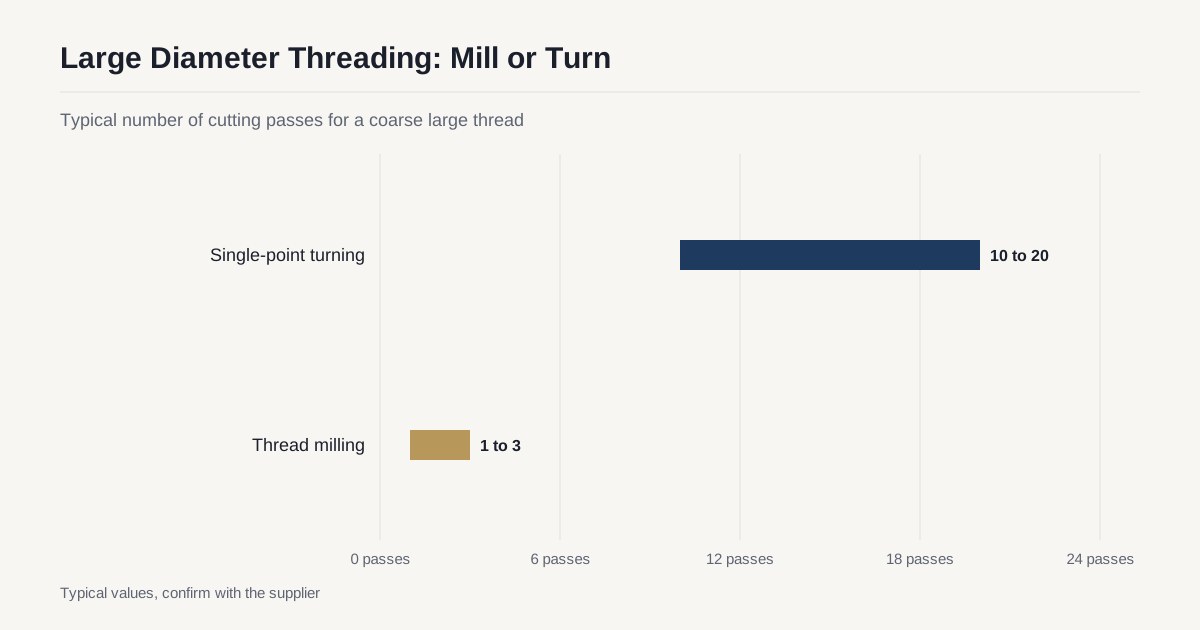
The part rotates on a lathe, which on a large part usually means a vertical turning lathe. A single-point tool moves along the axis in step with the rotation, one pitch per turn, and cuts a little deeper on each pass. A coarse thread may take ten to twenty passes, with the depth per pass getting smaller as the form fills.
What it does well. It produces a good thread form over a long length, for external threads on shafts and tubes and for internal threads in bores. It handles special forms such as Acme, buttress and other profiles by using a tool ground to that form. It is also the usual route when the thread has to be concentric with a turned diameter, because both are cut in one clamping.
What it needs. Space at the end of the thread for the tool to leave the cut. That is why drawings carry a relief groove or a runout. If the thread has to stop hard against a shoulder, a single-point tool cannot do it cleanly.
What goes wrong. Chatter on a long, slender part, tool wear that drifts the pitch diameter between passes and an error in the thread start position if the machine loses synchronisation. Good shops check the pitch diameter during the cut, not just at the end.
Thread milling
A milling cutter shaped like one or more thread teeth moves around the part in a helix while the machine feeds along the axis. One full turn of the cutter path makes one pitch of thread. The part can stay still, which makes this the usual route when the part is too large or too awkward to rotate.
What it does well. The cutting forces are low and the chips are short, so it suits deep holes and tough materials. It can cut right to the bottom of a blind hole. One tool can cut right-hand and left-hand threads and, with an offset, adjust the thread size without changing the tool. It is also the safer route on a part that has taken a lot of machine time already, because a problem shows up gradually rather than all at once.
What it needs. A machine that can run helical interpolation smoothly, and a tool that fits the thread. Access matters, because the cutter is a rotating body that has to clear the thread bore while it orbits.
What goes wrong. The thread can come out slightly tapered or with a small error in the flank angle if the cutter deflects. A long thread may need the cutter to take several radial passes. Cycle time is longer than a single-point route on a long continuous thread.
Comparing the two
| Factor | Single-point turning | Thread milling |
|---|---|---|
| Machine | Vertical or horizontal lathe | Mill, boring mill or machining centre |
| Part motion | Rotates | Fixed |
| Good for | Long threads, special forms, threads concentric with a turned diameter | Blind holes, awkward parts, tough materials |
| Needs | Relief groove or runout | Cutter clearance and smooth interpolation |
| Typical passes | Many, with decreasing depth | One to a few radial passes |
| Risk of scrap | Moderate | Lower, since the cut builds up gradually |
The table is general, so confirm the real route with the supplier. A shop that has one machine type will usually quote that route, and the buyer sees the difference as a different price rather than a different method.
How the thread is checked
On a small thread a go and no-go ring gauge settles the question. On a large thread a ring or plug gauge of the right size is heavy, expensive and often does not exist. Shops use other methods.
Pitch diameter by wires. Wires of a known size sit in the thread grooves and a micrometer measures over them. The pitch diameter follows from a formula. It works for external threads and for internal threads with the right equipment.
Thread micrometer or calliper. For external threads a micrometer with thread-shaped anvils measures pitch diameter directly.
Major and minor diameters. Measured with a micrometer, bore gauge or tracker. They do not prove the thread is acceptable on their own but they catch gross errors.
A purpose-made gauge. If the same thread is cut many times, the shop or the buyer may make a gauge. This is common on repeated flange threads and tooling.
Tell the shop which method you accept. For a large thread that connects to a mating part, a trial fit with the mating part is often the final test, and it may be agreed in advance.
What belongs on the drawing
A thread callout carries more than the size. The shop needs these items.
- The thread standard and tolerance class, such as ISO metric with 6g or 6H, or the Unified standard with 2A or 2B. If the thread is a special form, give the full profile.
- The pitch or threads per inch, and the hand, right or left.
- The thread length and whether it is full thread or has a runout.
- A relief groove or a stated alternative if the thread must stop at a shoulder.
- The surface finish on the flanks, if it matters for sealing or fatigue.
- Any coating or plating that adds thickness, since it changes the pitch diameter.
Coating is easy to forget. A thread that gauges correctly before plating can fail after it, and the shop has to cut to a size that allows for the build-up. Say whether the tolerance applies before or after the finish. The tolerance across a large part guide covers the same question for ordinary dimensions.
Cycle time and cost
Neither route is always faster. Single-point turning moves quickly along a long thread, but it needs many passes, and each pass on a large diameter takes real time because the part turns slowly at that size. Thread milling uses fewer passes on a short thread but moves around the circumference at a lower feed, so a long thread takes longer than the same thread turned.
In practice the choice often follows the machine rather than the maths. A shop with a free vertical turning lathe will turn the thread. A shop with a boring mill and a part that is already clamped will mill it. What matters to you is that the quote states the route, so a surprise does not appear later as a request to change the drawing. If one shop quotes much higher than another for the same thread, ask whether they have assumed different routes.
Setup time matters too. A special thread form means a special tool, and a one-off thread may need a ground tool or a custom insert that is bought for the job. That tool cost belongs in the quote as its own line on a single part.
Thread and bore relationships
Many large threads sit in the same part as a bore or a pilot diameter that the mating part locates on. If the thread carries a load but the pilot locates the part, the relationship between the two matters more than the thread tolerance. On a turned part both can be cut in one clamping on a vertical turning lathe, which keeps them concentric. If the thread is milled in a separate setup, the shop needs to say how it will keep the relationship.
Material and condition
Material affects the choice. A thread in hardened steel is harder to cut than one in a soft or normalised condition, and a stainless thread tends to tear if the tool is dull. If the part is going to be heat treated, thread before or after is a real decision. Threads cut before heat treatment can distort, and threads cut after are slower. The heat treatment distortion guide explains how shops plan this.
Closing checklist
- Give the thread standard, class, pitch and hand.
- Add a relief groove, or say that a shoulder stop is essential.
- State how the thread will be checked.
- Say whether coating applies and whether the tolerance is before or after it.
- Mark the relationship between the thread and any pilot or bore.
When the drawing is ready, send it with the RFQ and note any thread that must mate with an existing part.
Frequently asked questions
Can a large thread be cut with a tap?
Only up to a modest size. Beyond that the torque, the chip load and the cost of the tool make taps impractical, and the thread is cut by milling or turning instead. A shop will tell you its limit for your material.
How is a large thread checked if no ring gauge exists?
Common methods are measuring the pitch diameter with wires or a thread micrometer, checking the major and minor diameters directly and using a purpose-made gauge when the thread is repeated often. Agree the method before the job, not after.
Why does a thread drawing need a runout or relief groove?
A single-point thread needs space for the tool to leave the cut. Without a groove the thread has to end at a shoulder, and a shop may need to approve a milled route instead. A short groove on the drawing keeps both options open.
Need a quote for a part like this?
Send the drawing with the envelope and finished weight. We match you with up to 3 shops that take parts this size and reply within 24 business hours.
Get matched with a large part shop