Guides / Process
Machining Large Pump Casings and Valve Bodies
October 17, 2026
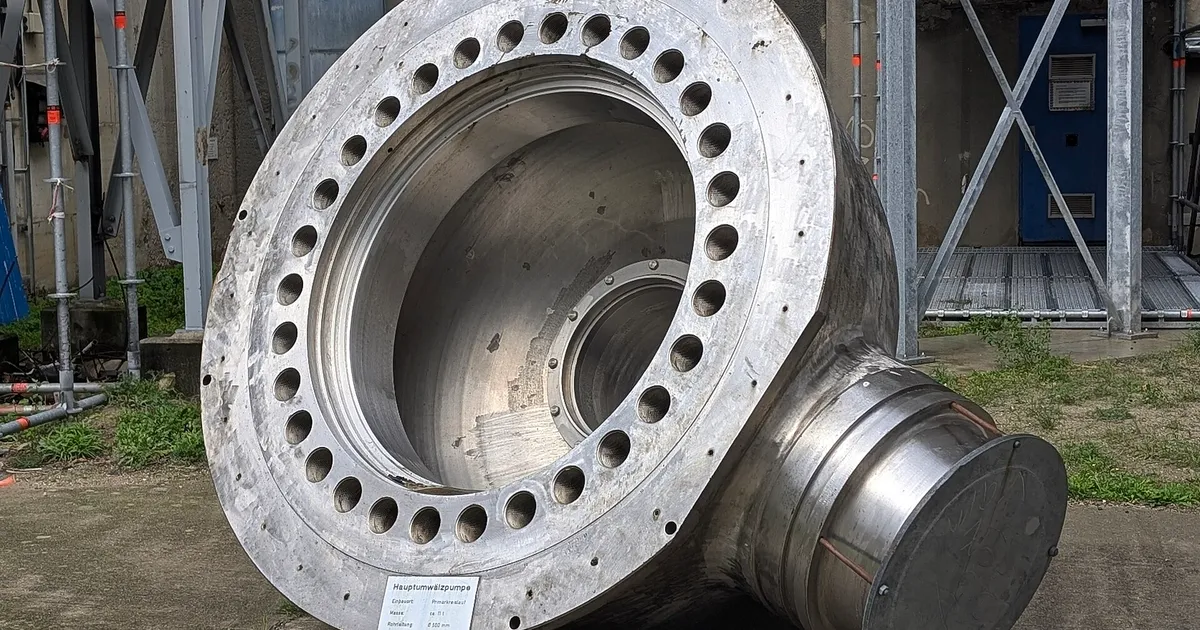
Pump casings and valve bodies hold pressure. They are cast, then machined where they seal, locate or connect. Machining a pressure casting is about more than dimensions. It also decides whether the part leaks, so the quality of the casting and the care in finishing the sealing surfaces matter as much as the tolerance.
This guide explains what is machined on these parts, where problems appear and what to put in an RFQ.
What is machined and what is not
Most of a casting is left as cast. The shop machines only the surfaces that need accuracy.
On a pump casing:
- Suction and discharge flange faces, and their bolt holes.
- Wear ring seats and bores for the impeller clearance.
- Bearing housing faces and bores, or the seal chamber.
- The split face on split casings, and the dowel and bolt holes.
- Feet and mounting faces.
On a valve body:
- End flange faces, including raised faces or ring-joint grooves.
- Seat bores and seat faces.
- Stem bore and packing chamber.
- Bonnet face and bolting.
- Body-to-body or body-to-cover joints.
The cored passages, such as the volute, the waterways and the ports, stay as cast. Their quality depends on the foundry. If a machined cut opens into a poor internal wall, the shop cannot fix it.
Materials
Pump and valve castings come in a wide range: carbon steel such as WCB, stainless grades such as CF8M, duplex stainless, ductile iron, cast iron and bronze. The service decides: water, seawater, chemicals, oil and gas or slurry. Each material changes how the part cuts.
The machining large stainless parts and machining large ductile and gray iron castings guides describe the behaviour of the common ones, and machining large bronze and copper castings covers the bronze pumps used in marine duty.
Where porosity shows up
A casting that holds pressure must have walls with no leak path. Thick sections, such as flange necks and valve body junctions, are the hardest to cast sound, because they freeze last and can shrink. A pore inside the wall may be harmless until a machining cut opens it, and then it forms a path from the inside to the outside.
Foundries use feeders, chills and process control to avoid it, and inspection methods such as radiography, ultrasonic testing and penetrant testing detect what remains. Pressure castings for demanding service come with inspection requirements in the purchase order. For a casting that will be machined, check the acceptance standard and the repair rules in advance. Some specifications allow repair by impregnation or by welding in defined areas, and others forbid it.
Finish on sealing surfaces
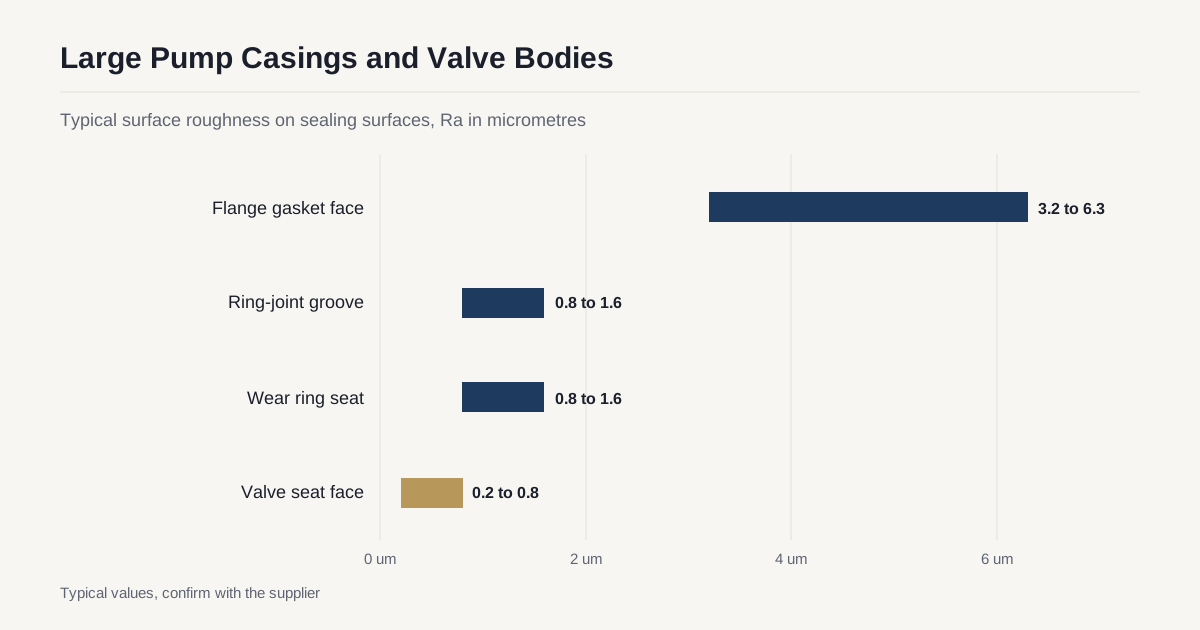
| Surface | What it seals | Typical roughness range, Ra |
|---|---|---|
| Flange gasket face | Flat or spiral wound gasket | 3.2 to 6.3 micrometres, serrated |
| Ring-joint groove | Metal ring gasket | 1.6 micrometres or better, per the flange standard |
| Wear ring seat | Clearance and press fit | 0.8 to 1.6 micrometres |
| Valve seat face | Shut-off tightness | 0.2 to 0.8 micrometres, often lapped |
| Bonnet or cover face | Body joint gasket | 3.2 to 6.3 micrometres |
The ranges are typical, so confirm the real figures with the flange standard, the gasket supplier and the valve design.
Flange standards such as ASME B16.5 and EN 1092-1 describe facing and finish for pipe flanges, and the ring groove standard describes the profile for ring joints. Use the standard that governs your part. The way a finish is written on a drawing matters too, and surface finish callouts for sealing faces explains the common mistakes.
Machining a split pump casing
Large double-suction and multi-stage pumps often have a casing split horizontally along the shaft axis. The method matches that of a gearbox housing. The shop machines the split faces, assembles the halves with dowels and bolts them, and then bores the wear ring seats and bearing bores through both halves in one setup, so the bores are round and aligned across the split. See machining large gearbox housings, which uses the same approach.
Alignment between the wear ring seats and the bearing bores decides whether the impeller runs true. A casing bored in one setup keeps those features concentric, as discussed in large bore machining and coaxiality.
Machining a valve body
Valve bodies are smaller than pump casings but complex. The body has an inlet and outlet that align, a seat bore at right angles to the flow in some designs, and a stem bore perpendicular to the seat. Several bores must meet at known angles and positions. A boring mill with a rotary table does this in one setup.
Seat faces call for tight flatness and finish. They are often lapped after machining, and some bodies receive a hard overlay on the seat, which brings its own requirements. See machining weld overlay and clad surfaces for the minimum thickness and sequence that overlay needs.
Pressure testing
After machining, pressure castings go through a hydrostatic test, usually at a multiple of the design pressure held for a set time, as set by the governing standard such as API 598 or ASME B16.34 for valves. A leak at this stage sends the part back for repair or scrap.
Agree in advance who performs the test, with what fluid, at what pressure, and how a failed test is handled. If the shop does not have test equipment, a test house may do it, and the schedule and the transport must allow for that. Tell the shop whether you require a test report with the part.
Cleanliness and preservation
Pump and valve parts often go to clean service. Chips and coolant must be removed from every passage, and machined surfaces must be protected. For parts in stainless steel, avoid contact with carbon steel tools and fixtures to prevent iron contamination. The corrosion protection after machining guide covers rust preventives and packing, and they apply to flanges and seats.
A worked example
Take a double-suction pump casing in carbon steel casting, about 2.2 metres long and weighing 3.5 tonnes. The casting arrives with radiography records for the thick flange necks and a magnetic particle report. The shop faces the split faces and the two flanges on a gantry mill, then drills and reams the dowel holes and assembles the halves.
On the boring mill, with the halves bolted together on the rotary table, the shop bores the wear ring seats at both ends and the bearing housings in one setup. A cut on one wear ring seat opens a small pore, about 2 mm across, in the wall near the seat. The shop stops and sends a photograph and a position sketch to the buyer. Because the order named the acceptance standard and the repair rule, the answer comes the same day: repair by an approved procedure in that area is allowed, with re-inspection.
After the repair and the remaining machining, the casing goes to hydrostatic test at the specified multiple of design pressure. It holds. The report goes with the part. Without the radiography records and the agreed repair rule, the pore would have been a dispute about whose fault it was and how to fix it. The cutting was routine, and the risk lay in the casting and in the paperwork around it.
Cost and lead time
The machining hours for a pump casing or valve body are modest compared with the blank and the testing. Casting lead time, inspection, repair and pressure testing often set the schedule. A casting for a new design needs a pattern, and for large sizes foundry capacity can be tight. Read lead time on large machined parts for how the blank and the machining combine.
Scrap risk shapes the price. A casting that fails at the last test has absorbed all the machining hours, so shops price some contingency into pressure parts. The better the casting inspection and the clearer the repair rules, the smaller that contingency needs to be.
What to put in the RFQ
- Casting material, specification and heat treatment.
- Casting inspection requirements and acceptance limits.
- Flange standard, face type and finish.
- Seat, wear ring and bore tolerances and finishes.
- Pressure test requirement and who performs it.
- Overlay requirements, if any.
- Cleanliness and preservation requirements.
- Casting weight and who supplies the casting.
Closing checklist
- Name the casting standard and inspection level.
- Give the flange standard and the gasket type.
- State the finish on every sealing surface.
- Agree the pressure test and the handling of failures.
- Decide who carries the risk of a defect found after machining.
To start a quote, send the drawing and casting data through the RFQ form.
Frequently asked questions
Why do pump casings leak after machining?
Usually because porosity in a thick section was opened by the cut and runs through the wall. It can also come from a flange face that is not flat or a gasket seat with the wrong finish. A hydrostatic test after machining finds the first kind.
What surface finish does a flange face need?
It depends on the gasket and the flange standard. Serrated finishes of a few micrometres Ra are common for flat and raised faces, and ring-joint grooves have their own limits. The flange standard and the gasket supplier give the numbers.
Are the internal passages machined?
Mostly not. Volutes, waterways and ports are cored and cast, and only the surfaces that seal or locate are machined. That is why the casting quality inside matters and why a machined cavity can reveal what the foundry left.
Need a quote for a part like this?
Send the drawing with the envelope and finished weight. We match you with up to 3 shops that take parts this size and reply within 24 business hours.
Get matched with a large part shop