Guides / Process
Large Ring Gears and Gear Blanks From Turning to Hobbing
October 18, 2026

A large ring gear looks like a simple part: a big ring with teeth on the outside or the inside. It is one of the least forgiving parts a heavy shop makes, because every step affects how the teeth run. A ring gear on a mill drive or a slewing ring has to mesh smoothly with a pinion for years under load.
This guide follows a large ring gear from raw ring to cut teeth and explains where accuracy is won or lost.
The blank
Large ring gear blanks are usually one of three types.
A rolled ring forging. A forged ring is expanded on a ring rolling mill to a larger diameter. It has a strong, aligned grain along the circumference, which suits gears. Rolled rings are available up to large diameters, within the limits of the mill.
A cast ring. Used for very large gears and for gears with a web and hub cast in. Casting allows the shape to include spokes and ribs.
A fabricated blank. A plate-rolled and welded ring, or a weldment of rim and hub. Used when time or size rule out a forging.
Material is usually alloy steel, such as 42CrMo4 or similar, supplied in a condition suited to the gear process. The blank type and material are fixed by the gear designer and the standard that governs the gear class.
Turning the blank
The blank goes to a vertical turning lathe, which is the natural machine for a large ring. The part rotates on a horizontal table, and gravity holds it flat. The vertical turning lathe versus horizontal lathe guide explains why.
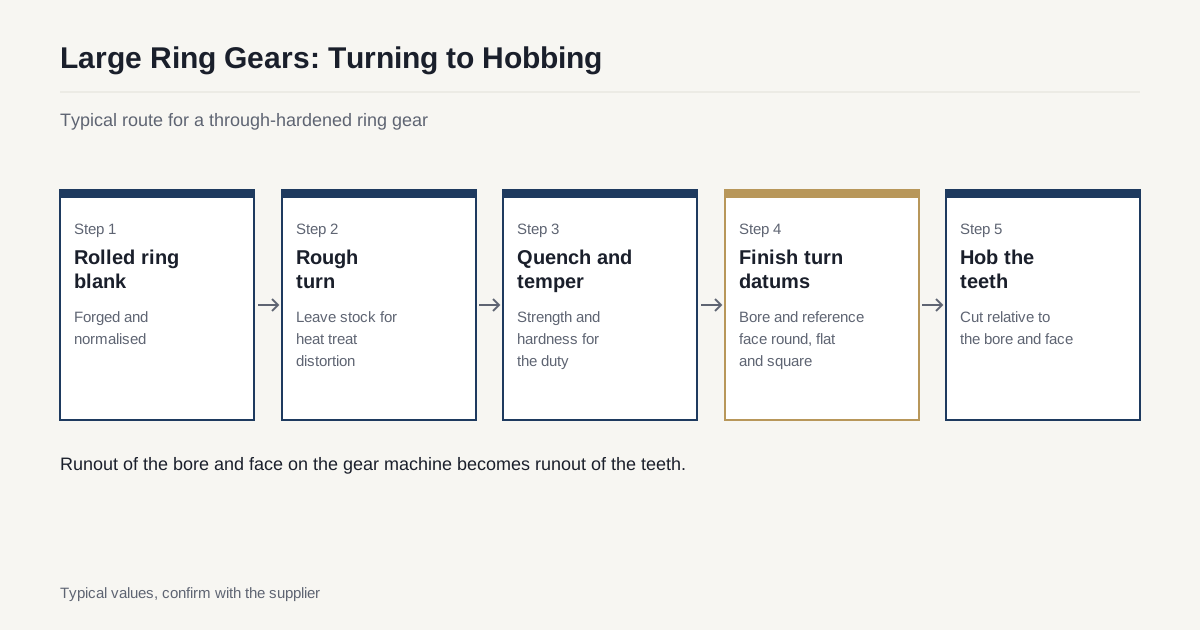
The first operation is rough turning. The shop removes the skin and bulk metal from the faces, bore and outer diameter and leaves stock for later steps. If the ring will be heat treated, it leaves enough for the distortion that heat treatment will cause.
The second operation, after any heat treatment, is finish turning of the datum surfaces: the bore, the reference face and sometimes the outside diameter. These surfaces locate the ring on the gear machine, so their quality sets the quality of the gear.
Heat treatment and distortion
Gears take their strength from heat treatment. Two routes are common.
Quench and temper. The ring is hardened throughout, then tempered to the required strength. Teeth are cut afterward by hobbing or milling in the heat-treated material, which is slower but avoids distortion of the cut teeth.
Case hardening. The teeth are cut in soft material, then the ring is carburised, hardened and tempered, which leaves a hard surface and a tough core. Heat treatment changes the shape of the teeth, so they are finished afterward by grinding or hard finishing.
Large rings distort in the furnace. They go out of round, the faces warp and the bore changes size. The shop plans for it with extra stock and a finish machining step after. See heat treatment distortion on large alloy parts for how that is handled.
Cutting the teeth
Large gear teeth are cut in a few ways.
- Hobbing. A rotating hob, shaped like a worm with cutting edges, cuts the teeth as the ring turns. It is fast and accurate for external gears and is the usual route for large rings within the capacity of the machine.
- Gear milling with form cutters. A disc or end mill shaped like the tooth gap cuts one gap at a time and indexes. It suits very large modules and diameters, and large internal gears, where a hobbing machine is not available.
- Gear shaping. A reciprocating cutter shaped like a gear cuts teeth, and it suits internal gears and shapes where a hob cannot reach.
The machine capacity, the module and the diameter decide which route is available. Large hobbing machines exist, but there are few of them, and a gear that is bigger than a shop’s capacity goes to a specialist. Ask early who will cut the teeth.
Accuracy classes
Gear accuracy is defined by standards such as ISO 1328 and AGMA 2015, which set limits on pitch, profile and runout. A lower class number or a higher quality number means tighter limits, depending on the standard. Ask the gear designer which class applies, and what it requires of the blank.
| Step | What it sets | Typical concern |
|---|---|---|
| Turning datum surfaces | Runout and squareness of the blank | Round and flat bore and face |
| Heat treatment | Strength and hardness | Out of roundness, warped faces |
| Tooth cutting | Pitch, profile and tooth thickness | Machine capacity, blank runout on the table |
| Hard finishing, if used | Final tooth accuracy | Capacity for large diameters |
The table summarises where each step contributes, so confirm the actual limits with the gear standard and the supplier.
Runout on the gear machine
The gear machine clamps the ring by the bore and the face. If those surfaces run out by 0.05 mm when the ring is set up, the teeth will run out by about the same. The shop therefore checks and trims the setup with a dial indicator before cutting, adjusts the clamping and in some cases takes a light finish cut on the clamping surfaces in place.
For the buyer this means the blank datums should be defined on the drawing with tolerances, and the shop must keep them intact through heat treatment. Read GD&T datum strategy for large parts for how the datum scheme links the blank and the finished gear.
Splitting and assembly
Very large ring gears, such as those on grinding mills and kilns, are made in segments that bolt together at site. Each segment is machined with its split faces and bolt holes, and the segments are assembled and checked as a set before shipping. Some are finish machined after assembly so the joint faces are true.
Segment sets need careful marking and handling, because segments cut as a set are not interchangeable. Ask the shop how it marks and keeps sets together.
Balance and mass
A large gear is a heavy rotating part. If it runs at speed, residual unbalance causes vibration. Balance requirements come from the application. The balancing large rotating parts guide covers when and how.
Mass also decides what the shop can handle. A ring that weighs many tonnes needs a crane, a table with enough load rating and a plan for lifting it without distortion. See table load and crane capacity for why this matters in the quote.
A worked example
Take an external ring gear of about 2 metres in diameter, a rolled ring forging in alloy steel, to be quenched and tempered and then hobbed. The blank arrives with a certificate and ultrasonic test record. The shop rough turns the bore, faces and outside diameter on a vertical turning lathe, leaving about 4 mm on each surface for the distortion of heat treatment.
After quench and temper, the ring is measured. It has gone slightly oval, with the bore 0.6 mm out of round, and one face has a small dish. The shop takes a finish cut on the bore and the reference face in a single setup so that the two are square to each other, and checks them with an indicator while the table turns. Runout settles under 0.02 mm.
On the hobbing machine the ring is clamped by the bore and face. The operator indicates the bore again, adjusts until the runout is within the limit set for the gear class and starts cutting. After the teeth are cut, the shop measures pitch and runout and prepares the report. Had the finish turning been skipped, the oval bore would have gone straight into the teeth. The turning, which looks like a plain operation, is where the gear’s accuracy is secured.
Cost and lead time
Large gear work carries cost in four places: the forging or casting, the turning, the heat treatment and the tooth cutting. Lead time is often set by the blank and by access to a gear machine of the right size, since there are few of them. Hard finishing by grinding adds more again, and capacity for very large diameters is limited.
If the teeth are cut by a different shop, transport adds time and handling risk, and the datum surfaces must arrive undamaged. The shipping oversized machined parts guide covers how to protect finished surfaces in transit. Ask each shop to state what it does itself and what it subcontracts, and ask for the plan for the handover between suppliers.
What to put in the RFQ
- Gear data: module, number of teeth, pressure angle, face width, accuracy class and the governing standard.
- Material and heat treatment route.
- Blank type and weight, and who supplies it.
- Datum surfaces and their tolerances.
- Whether the shop cuts the teeth, or only turns the blank.
- Inspection method and the report you expect.
Closing checklist
- Give the full gear data and the accuracy class.
- Fix the heat treatment route before the blank is machined.
- Define the bore and face datums with tolerances.
- Ask who cuts the teeth, and with what machine.
- Mark segment sets and keep them together.
To send the gear data and drawing together, use the RFQ form.
Frequently asked questions
Why does the gear blank matter so much?
Because the gear is cut relative to the bore and the faces. If those surfaces run out when the blank is clamped on the gear machine, the teeth will run out too. The blank is turned so that its datum surfaces are round, flat and square to each other.
Are teeth cut before or after heat treatment?
Both are used. Through-hardened gears are often hobbed after quench and temper. Case-hardened gears are cut soft, carburised and hardened, and then finished by grinding or hard finishing. The route depends on the gear class and the duty.
Can a shop that turns the blank also cut the teeth?
Not always. Large gear cutting needs a hobbing machine or gear milling capability sized for the diameter and module. Many shops turn the blank and subcontract the teeth, or the other way round, so the RFQ should say who does what.
Need a quote for a part like this?
Send the drawing with the envelope and finished weight. We match you with up to 3 shops that take parts this size and reply within 24 business hours.
Get matched with a large part shop