Guides / Materials
Cast Steel or Forged Steel Blank: What Changes on the Machine
October 11, 2026
When a large part has a complex outer shape, a buyer often has to choose between a steel casting and a steel forging, or sometimes a weldment. The choice is made on cost, shape and duty, and it carries on into machining. A casting and a forging of the same grade do not cut the same way.
This guide covers what changes on the machine and what a buyer should settle before the blank is ordered.
How each blank is made
A steel casting is made by pouring molten steel into a mould, usually sand, that follows a pattern of the part. The metal solidifies, the casting is cleaned, heat treated and sent for inspection. Complex shapes with cavities and varied wall thickness are possible, and the blank is close to final shape.
A steel forging starts as an ingot or a billet. It is heated and shaped by presses or hammers. Closed-die forging uses a shaped die and suits repeat parts. Open-die forging, used for the largest and most one-off parts such as shafts, rings and blocks, shapes the metal with flat or simple tools and leaves more to machine.
The shape and the process leave their mark on everything that follows.
Internal quality
Forging squeezes the metal and closes most of the voids from the ingot. It aligns the grain along the part, which raises strength and toughness in the direction of the flow. Properties are directional, so the drawing or the specification should say where the test pieces are taken.
A casting is more isotropic, with no grain flow, but it can hold porosity, shrinkage cavities and inclusions in the thick sections, where the metal froze last. Good foundry practice reduces these with feeders and chills, and inspection finds what remains. That is why castings for demanding duty carry non-destructive testing and sometimes radiography.
None of this makes a casting poor. Many large pump bodies, valve bodies and structural housings are cast, and they meet their duty. The point is that the inspection and the acceptance limits carry more weight on a casting than on a forging.
What changes on the machine
| Factor | Cast steel blank | Forged steel blank |
|---|---|---|
| Surface | Sand burn-on and scale, rough skin | Scale, often with tool marks from the press |
| Hardness | Can vary across the part | Usually uniform |
| Hidden defects | Porosity, inclusions, repaired areas | Seams and laps, internal flaws in very large sections |
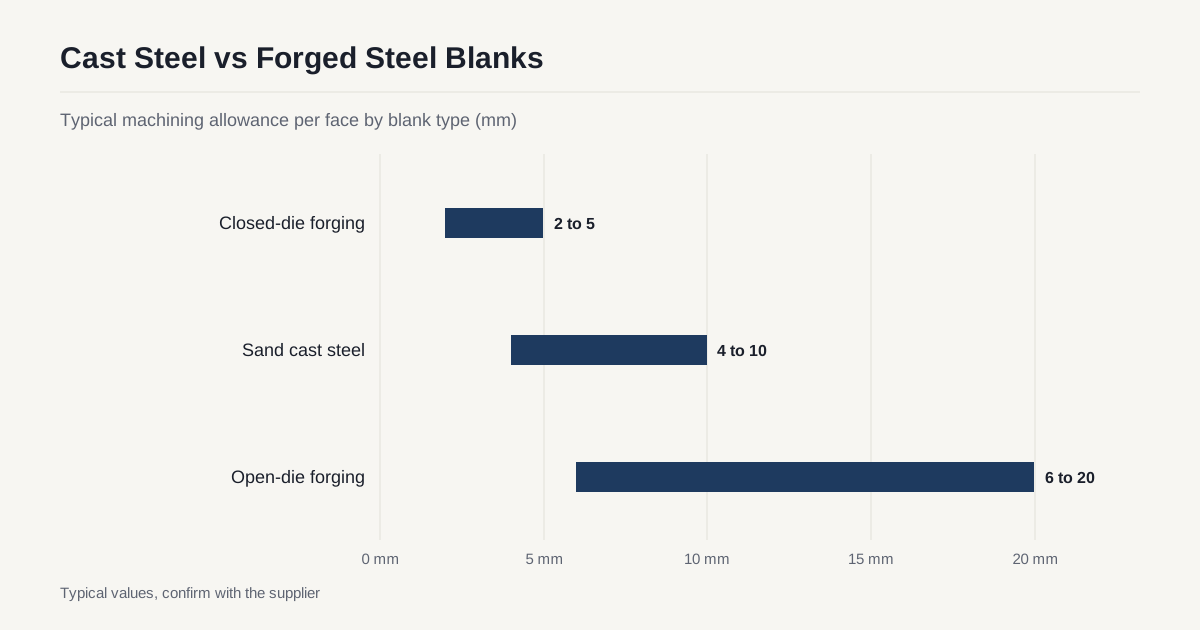
| Typical allowance per face | 4 to 10 mm | 3 to 20 mm, more on open-die |
| Shape accuracy | Good near net on complex shapes | Simple shapes, more machining on open-die |
| Movement during machining | Depends on heat treatment and section changes | Depends on size and stress from forging and heat treatment |
These are typical figures, so confirm them with the foundry or forge and the shop.
Cast skin
The skin of a steel casting carries sand burned into the surface and a layer of scale. It is hard on inserts. The first cut must go under it, with a tough insert grade and enough depth. Forgings carry scale too, and the same rule applies. The heavy roughing tools guide describes how shops cut under a rough skin.
Hardness variation
In a casting, thin sections cool fast and thick sections cool slowly, so hardness can vary after heat treatment. Welded repair areas can be harder than the surrounding metal, and tools hit these spots without warning. Forgings are usually more uniform, so tool life is more predictable.
Allowance
Castings made from a good pattern can hold less allowance than open-die forgings, which are shaped from simple tools and need generous stock. The result is that for a complex shape, a casting often removes less metal, and for a simple shape, a forging or a plate may be simpler. See machining allowance on large blanks for how shops treat allowance.
Movement and stress
Both blanks hold stress. A casting has cooling stress, which depends on shape, and a forging has stress from the working and from heat treatment. When the shop removes metal, the stress rebalances and the part moves.
A shop will often rough both types, stress relieve or rest the part and then finish. Large castings with big changes in section are the most likely to move in unexpected ways. The stress relief before finish machining guide explains the sequence. The forging, casting or weldment guide covers the earlier decision about which route to choose.
Inspection and certification
Both types come with material certificates. For critical parts, the buyer may ask for more.
- Chemistry and mechanical tests, from a test coupon or test ring, with the heat number traceable to the part.
- Ultrasonic testing of thick sections, especially for forgings and for castings with critical walls.
- Magnetic particle inspection of machined surfaces to find surface-breaking flaws.
- Radiography of critical sections of castings.
Name the standards in the purchase order. Typical specifications include ASTM A216 for carbon steel castings and ASTM A668 for forgings, and EN standards in Europe, but the correct one depends on duty and region, so check the standard that applies to your part.
Repairs
Foundries repair casting defects by grinding out and welding under a procedure, followed by heat treatment and inspection. Specifications limit the size and location of repairs, and many forbid them in critical areas. A repaired area that is harder or softer than its surroundings can show up during machining.
Forgings are rarely repaired. A forging with a flaw is usually rejected and remade.
Tell the shop whether repairs are allowed, and ask the foundry for repair records. If a defect appears during machining, the question of who decides and who pays should already be answered in the order.
A worked example
Take a large valve body that weighs about 2.5 tonnes finished, with a through bore, two flanges and an internal cavity. A casting suits this shape, because the cavity can be cored in and a forging would need heavy drilling and a large block. The foundry delivers the casting after normalising and tempering, with a chemistry report, a mechanical test report from an attached test block and a record of one weld repair on a flange.
The shop measures the casting on the table. The flange faces have 5 mm of allowance and the bore has 6 mm on diameter. A first cut under the skin of the flange shows a small hard spot over the weld repair, which the shop handles with a fresh insert and a lower feed over that area. The bore, cut after a rest, runs cleanly.
Now compare a forged shaft of 1.8 tonnes. The forging arrives as a ring-rolled and turned blank with 10 mm of allowance on diameter. It is uniform and predictable, with no internal cavities to worry about, and the shop roughs it at a steady rate. The cost sits in the extra metal removed and the forging lead time, not in surprises. Both parts are steel, and the risks sit in different places.
Cost and lead time
A casting needs a pattern, unless one already exists, and the pattern can take weeks to make and cost a meaningful share of a one-off part. Once it exists, repeat castings are quicker. A forging needs an ingot or billet and a slot in the forge’s schedule. Open-die forgings suit one-offs without tooling, but the forge lead time can still be long. The lead time on large machined parts guide explains how blank time and machining time combine.
On the machining side, a casting that is close to the final shape removes less metal, but the inspection and the risk of hidden defects add cost and uncertainty. A forging removes more metal but is more predictable. A fair comparison puts all of these on one sheet.
Which to choose
The choice is not only about the blank price.
- Choose casting when the shape is complex, with cavities or varied wall thickness, and when the quantity or the shape makes a pattern worthwhile.
- Choose forging when the duty is severe, when the shape is simple enough to forge and when you want predictable internal quality.
- Consider a weldment when the shape is large and simple and the lead time matters. The weldment or casting guide covers that trade.
If you are unsure, ask the shop to quote on the blank type you prefer, and ask for its view of the alternative. Shops see the effect of each blank on their machines.
What to put in the RFQ
- Blank type, specification and heat treatment condition.
- Blank weight and finished weight.
- Inspection requirements and acceptance limits.
- Whether repairs are allowed and where.
- Who supplies the blank and who carries the risk of hidden defects.
Closing checklist
- Name the specification and the heat treatment.
- State the inspection level and who performs it.
- Say what repairs are allowed.
- Expect more allowance on open-die forgings than on castings.
- Agree who decides when a defect appears during machining.
To bring these points into your request, use the RFQ form.
Frequently asked questions
Which is stronger, cast steel or forged steel?
At the same grade, forged steel usually has better strength, toughness and fatigue resistance, because forging closes porosity and aligns the grain. A well made casting can meet the specified properties, and the drawing or the specification sets the requirement.
Is cast steel cheaper than forged steel?
For complex shapes in small quantities it often is, because one pattern gives a near-net shape. For simple shapes, a forging or plate with more machining can be cheaper once the pattern and the casting inspection are counted.
Can I weld a defect in a steel casting?
Foundries do repair castings by welding under a controlled procedure and heat treatment, and specifications limit where and how. Never accept an unplanned repair near a critical bore or face without written agreement.
Need a quote for a part like this?
Send the drawing with the envelope and finished weight. We match you with up to 3 shops that take parts this size and reply within 24 business hours.
Get matched with a large part shop